
Hunt County Criminal Court Cases
Hunt County divides criminal dockets by offense level. The 196th District Court and 354th District Court exercise original felony jurisdiction, and the District Clerk keeps those cause files. County Courts at Law Nos. 1 and 2 hear Class A and Class B misdemeanors, with the County Clerk serving as custodian. Justice and municipal courts retain their own fine-only offenses, local ordinance cases, and related warrant records. That division controls where a search begins and where an official copy must come from.
The county's district-court explanation shows why a felony search belongs at the district level. The official view pictured below also helps distinguish the local trial courts from the jail and arresting agencies.
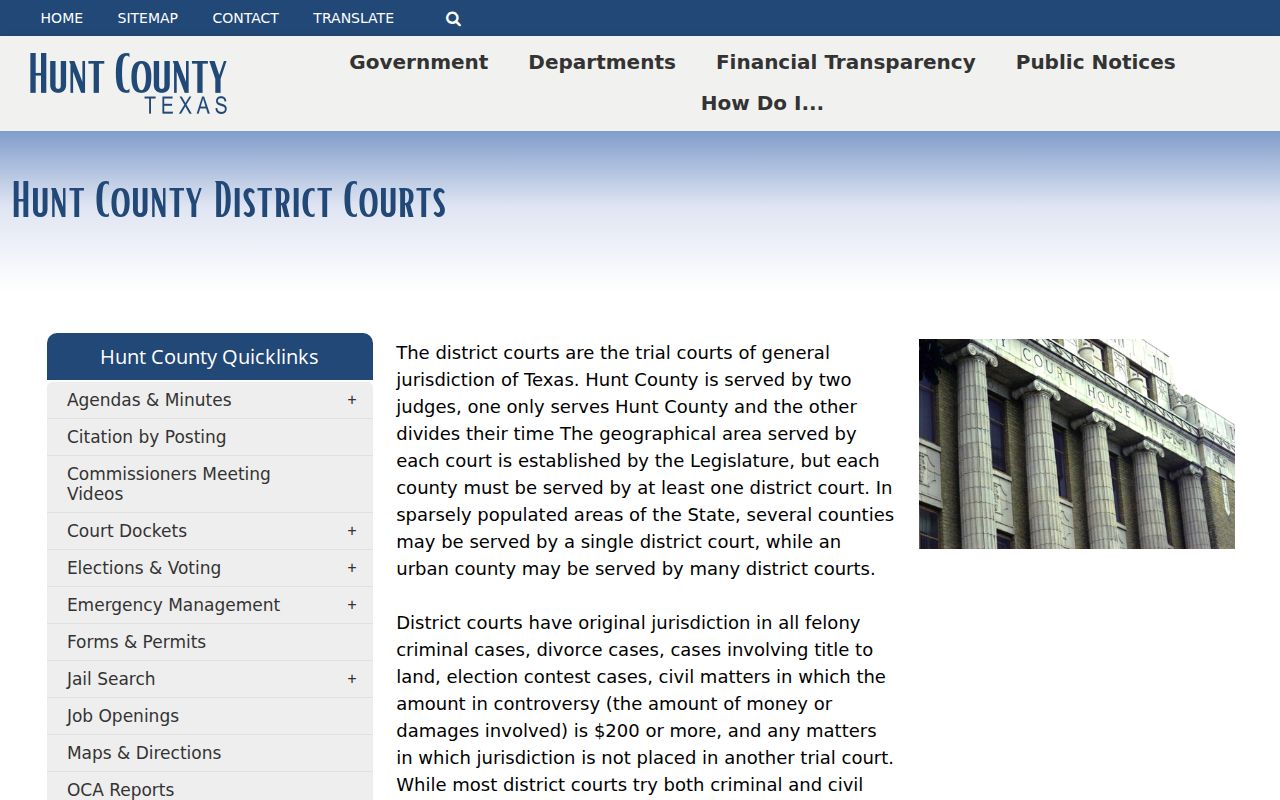
A booking record may name an intake charge, but only the Hunt County court file shows what prosecutors actually filed and how the judge resolved it.
Hunt County Felony Court Layers
The two district courts share felony jurisdiction without making their dockets interchangeable. A cause number, assigned court, or clerk search result points to the correct file. The 196th District Court is based in Hunt County. The 354th operates within a wider judicial-district setting. Both use the courthouse at 2507 Lee Street in Greenville, yet their calendars, orders, and case events remain court-specific.
The District Attorney prosecutes felonies. The County Attorney prosecutes misdemeanors, juvenile matters, and truancy cases. The Hunt County District Attorney page provides the felony office and victim-services route.
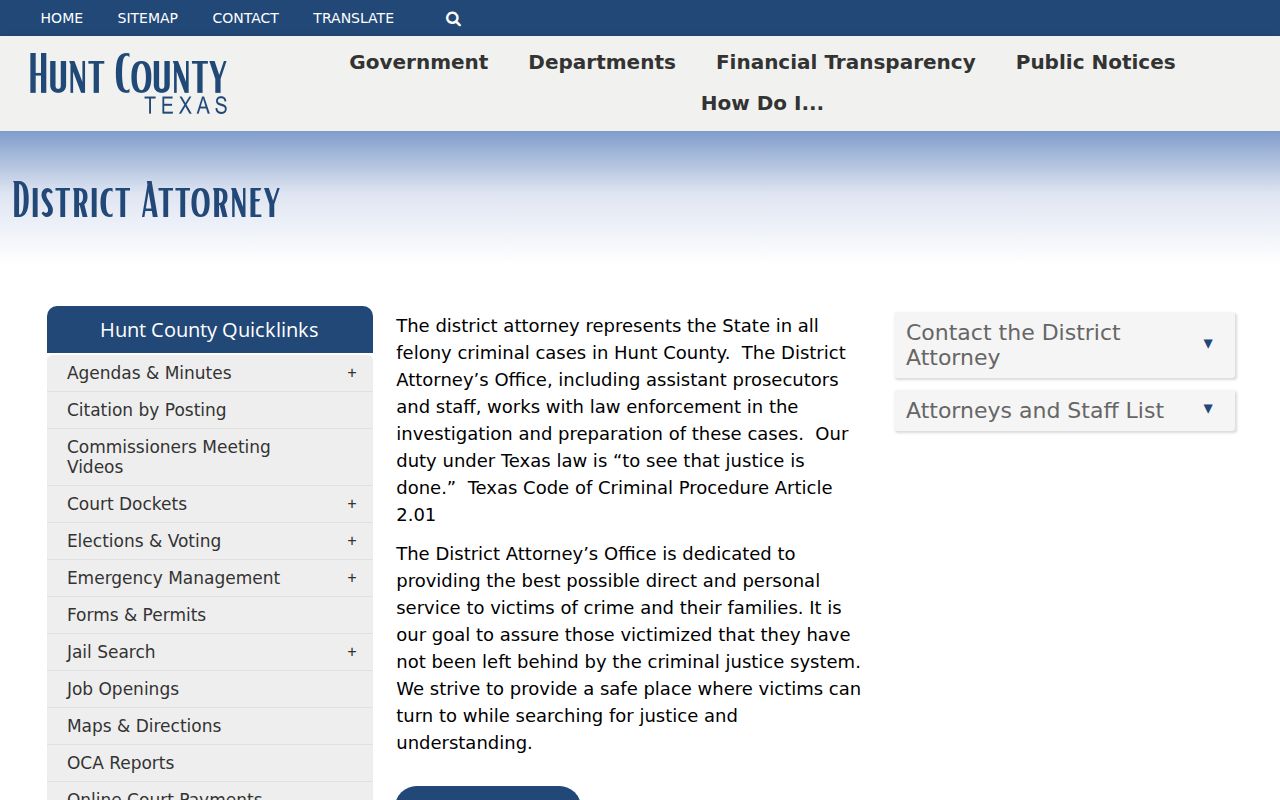
This prosecutor split explains why a felony pleading and a misdemeanor information may be filed by different offices even when both cases arise in Hunt County.
Searching Hunt County Case Records
Start with the court level, not a broad name guess. Hunt County Public Access is the first online route for district matters. The County Clerk points misdemeanor researchers to iDocket. Neither system replaces a certified clerk copy, and a public register of actions may appear even when a pleading image cannot be downloaded.
- Decide whether the matter is a felony, Class A or B misdemeanor, or fine-only municipal or justice-court case.
- Use Hunt County Public Access for district cases or the County Clerk's stated iDocket route for misdemeanor files.
- Search by cause number when available. Otherwise use a full party name, then narrow by court, filing period, status, or case type.
- Open the register of actions and compare the filed charge, docket status, disposition, judgment, and later events.
- Ask the correct clerk for the charging instrument and judgment when a complete or certified record is needed.
The Tyler deployment can change its exact controls, so visible field labels and required markers govern each search.
| Field Label | Type | Required | Use |
|---|---|---|---|
| Record number | Text | No | Best route when the full cause number is known |
| Party or business name | Text | No | Smart Search starting point for a defendant name |
| Case status | Filter | No | Narrows open or disposed matters |
| Filed date range | Date filter | No | Limits results by filing period |
| Case type and court | Filter | No | Separates criminal divisions and locations |
Two Hunt County Court Portals
Hunt County Public Access and iDocket answer related but different questions. The Tyler-hosted portal supports Smart Search for local court information and commonly accepts a record number or party name. Advanced controls can include status, filed dates, case type, party type, and court. The County Clerk separately identifies iDocket for misdemeanor, civil, and probate records. Account or vendor conditions can vary there.
When neither search exposes the needed document, the clerk remains the source. The District Clerk request form accepts a case number, defendant name, filing year, felony case type, date of birth for a felony search, and a description of the requested material. This is also the route for an older Hunt County criminal case whose online entry lacks an image.
Note: A portal screen can locate a Hunt County cause, but only the proper clerk can issue its certified judgment.
Inside a Hunt County Case File
A Hunt County case file is organized around a cause, not around every event in a person's criminal history. Read the filed charge apart from the original booking language. Then follow the register of actions through hearings, rulings, disposition, and sentence. A “disposed” label means the court finished or resolved the matter; it does not by itself say that a conviction occurred.
| Cause Number and Court | Identifies the local file and the tribunal assigned to it. |
|---|---|
| Charging Instrument | Shows the filed complaint, misdemeanor information, or felony indictment. |
| Docket Entries | Lists filings, settings, orders, and register-of-actions dates. |
| Hearings | Records scheduled or completed arraignment, pretrial, trial, and later settings. |
| Disposition and Judgment | States dismissal, plea, acquittal, conviction, or another case outcome when entered. |
| Sentence and Conditions | May show confinement, fine, community supervision, restitution, or later revocation events. |
Attorney roles, financial assessments, bond events, and document icons may also appear. Protected identifiers, victim or minor details, sealed records, and expunged material are not part of ordinary public access.
Hunt County Misdemeanor Path
Class A and B misdemeanors run through County Courts at Law Nos. 1 and 2. The County Clerk holds those judicial records, while the County Attorney handles prosecution. This path differs from a district felony in both custodian and charging instrument. A prosecutor generally files an information for the misdemeanor layer rather than seeking a grand-jury indictment.
The Hunt County Attorney page also publishes material for a Pretrial Intervention Program. Eligibility is a prosecutor and program decision, not an automatic case result or public-record right.
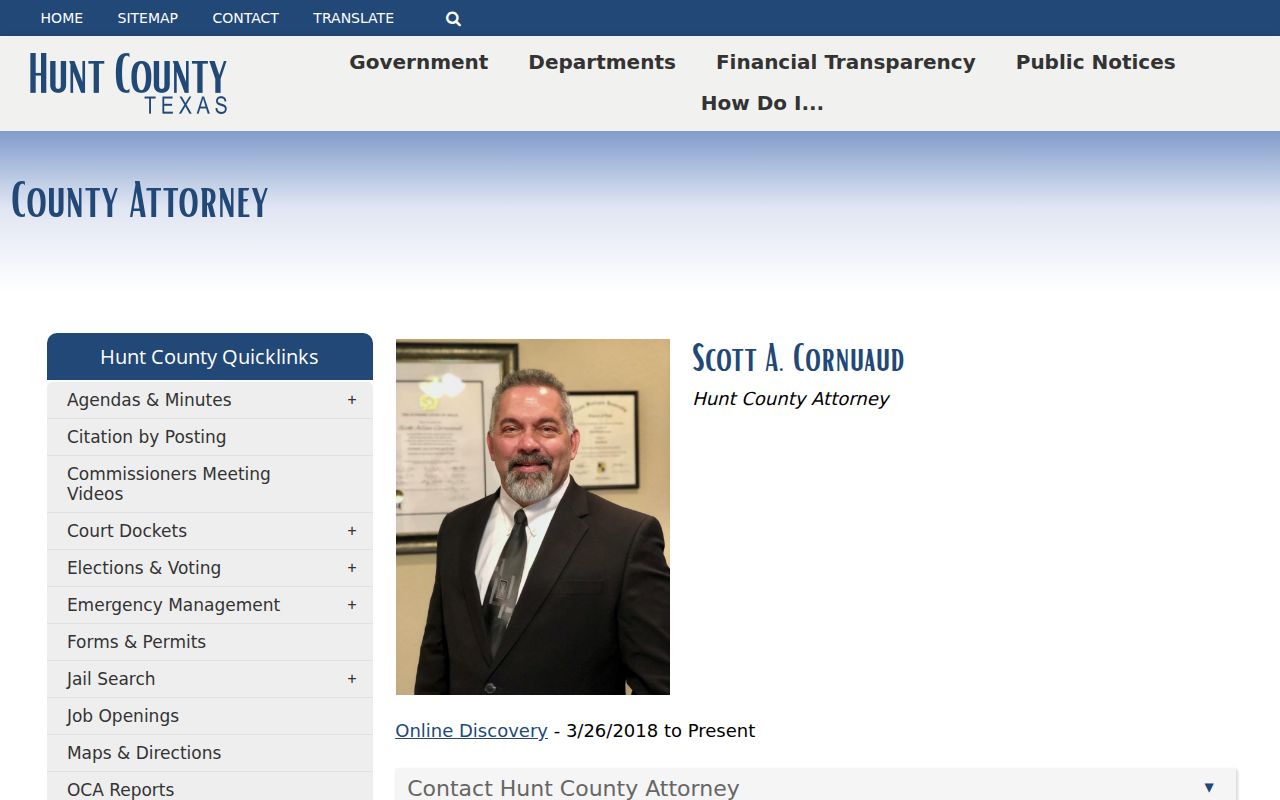
A participant should still read the filed docket and final order because program steps and the formal disposition are separate parts of the Hunt County record.
How a Criminal Case Moves
After an arrest, a magistrate gives warnings and addresses probable cause and bond. The prosecutor then decides whether and what to file. A misdemeanor may proceed by information. A felony may be presented to a grand jury, where a true bill yields an indictment and a no-bill means the proposed indictment was not approved. Arraignment and pretrial settings follow. The matter can end by dismissal, plea, trial, acquittal, or conviction.
Case flow: Charges Filed › Arraignment › Pretrial › Plea or Trial › Disposition › Sentencing
Later motions, appeal activity, and a community-supervision revocation can add new entries after the first judgment. Search the entire Hunt County docket rather than stopping at the first outcome label. The criminal court case record remains the controlling local source for those later filed events.
Hunt County Municipal Case Boundary
A Greenville fine-only case may never appear as a district-court cause. Municipal courts retain ordinance violations, many Class C matters, citations, and their own capias records. Justice courts also keep matters within their jurisdiction. If Tyler Public Access returns nothing, ask which court issued the citation or warrant before concluding that no court record exists.
The Greenville Municipal Court guidance illustrates this local boundary with its citation and warrant information.
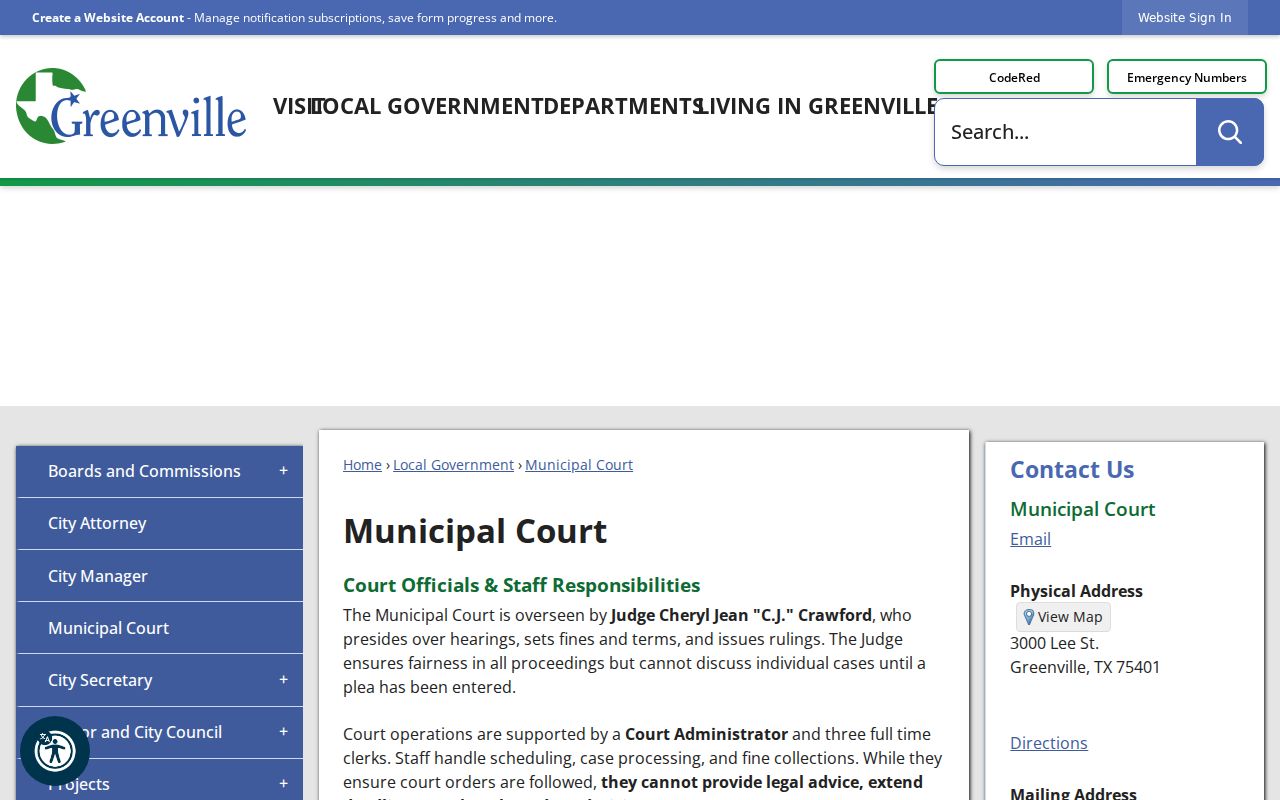
The image reinforces a practical rule: contact the issuing municipal court for its own fine-only case instead of sending every Hunt County request to the District Clerk.
Case Record Access and Restrictions
Filed judicial case records do not follow the same request path as a sheriff report. The Texas Public Information Act governs many executive-agency records, but Hunt County's County Clerk states that judicial records are not TPIA records. Court law and rules govern filed case access, while Texas Rule of Judicial Administration 12 addresses judicial administrative records. The custodian and record type therefore matter before a request is sent.
Public access also has firm limits. Juvenile files, protected victim information, full dates of birth, government identifiers, sealed or expunged material, and confidential documents can be hidden or redacted. A missing online image can reflect security settings rather than a missing case. Ask the clerk whether inspection or a lawful copy is available.
Hunt County Copies and Federal Cases
The District Clerk charges $5 per name for a staff search. Paper copies cost $1 per page. An electronic copy through ten pages costs $1, with each additional electronic page at $0.10. Certification and seal cost $5. These fees make a free portal search useful for locating the right cause before ordering a specific charging instrument or judgment.
Federal cases are outside the Hunt County clerk system. Hunt County lies in the Eastern District of Texas, and federal dockets use PACER after registration. The official PACER access page pictured below is the proper federal route.
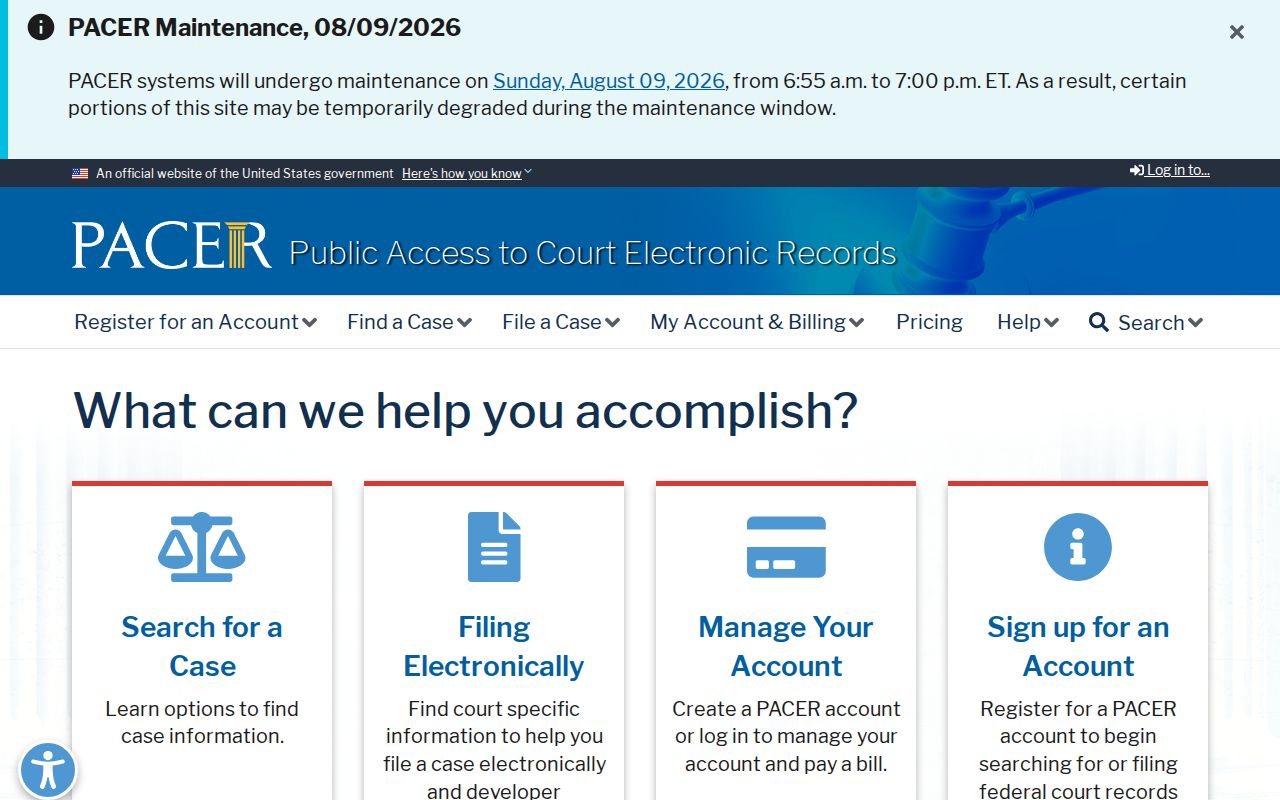
Absence from PACER says nothing about a state Hunt County cause, just as absence from a county portal says nothing about a federal prosecution.
Note: Match the jurisdiction first, then order only the Hunt County or federal document that answers the precise case question.